Data Governance Committees
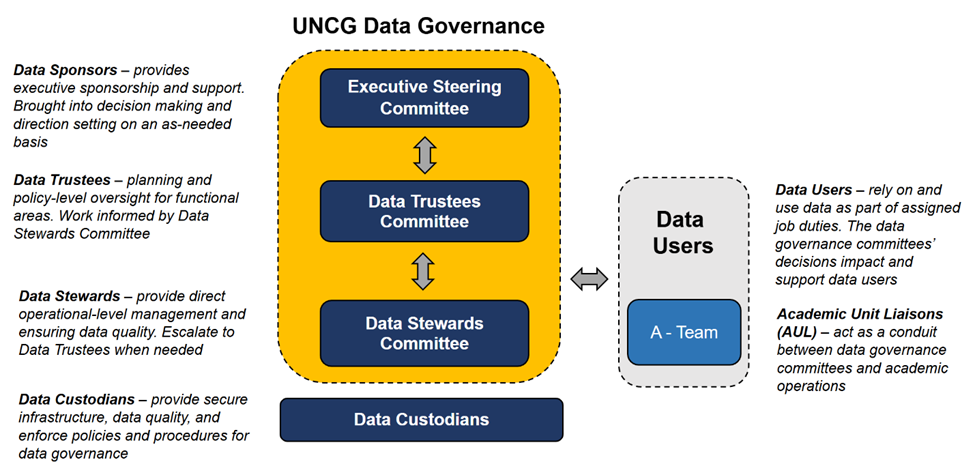
Data Governance at UNCG is comprised of the following committees: Executive Steering, Data Trustees, and Data Stewards. Each of these committee roles has a vested interest in furthering the mission of Data Governance and supporting a university-wide culture toward effective data creation, storage, management, and usage.
The individual roles and responsibilities of those within Data Governance, as defined in the Data Governance Structure Policy, are as follows.
Data Sponsor
The Data Sponsor provides executive-level sponsorship and support of UNCG data governance activities.
The Executive Steering Committee (ESC) serves as the current Data Sponsor for UNCG Data Governance. The Data Sponsor (i.e., the ESC) is trained, qualified, and responsible for supporting and sponsoring data governance initiatives. The Data Sponsor clears barriers to effective data governance and has a key role in communicating enterprise-wide initiatives to campus stakeholders. The Data Sponsor is regularly informed of data governance efforts and policy initiatives. Additionally, the Data Sponsor is responsible for securing funding for data governance activities and approving enterprise-level data governance policies. Data Sponsors understand the importance of sponsorship and support required for institutional data governance. Data Sponsors are accountable for governing institutional data in a safe and responsible manner.
Data Trustee
A Data Trustee is a senior University official (or their designee) who has planning and policy-level responsibilities for data within their functional areas and management responsibilities for defined segments of institutional data.
Data Trustees are responsible for assigning Data Stewards, participating in establishing policies and standards, and promoting data resource management for the good of the university. A Data Trustee plans and sets data policy and responds to data access and policy or standards implementation issues. Data Trustees are also responsible for approving data classification levels, and data storage and handling at each classification level.
Data Trustees (or Business Stewards) are responsible for planning and prioritizing data governance projects and initiatives. Data Trustees assign Data Stewards and communicate with Data Sponsors and Data Stewards. Data Trustees develop, approve, and support data policies and promote data resource management. Data Trustees are responsible for responding to access and policy implementation issues and outline training framework for Data Stewards and Users. Data Trustees may serve as consultants for Data Stewards and can implement data standards.
Additionally, Data Trustees establish, review, and report on Key Performance Indicators (KPIs) aligned with the strategic plan. Data Trustees also approve data access requests for the university. Data Trustees are trained, qualified, and understand implications of planning and policy-level decisions related to data within their functional areas. Data Trustees are held accountable for working with institutional data in a safe and responsible manner.
Data Steward
A Data Steward is a university official with direct operational-level responsibility for information management.
Data Stewards (Operational Data Stewards, Technical Stewards, or Data and Information Stewards) are responsible for operational-level metadata management and ensuring data quality. Data Stewards help build data literacy and have direct hands-on data responsibilities. Data Stewards handle data inquiries, train and onboard new staff, and elevate policy or standards changes to Data Trustees. Data Stewards are trained, qualified, and understand the implications of data management and quality across the institution. Data Stewards are held accountable for working with institutional data in a safe and responsible manner.
Data Custodian
Technology Custodians: Information Technology Services (ITS) and distributed campus technology personnel serve as Data Custodians. Technology Custodians provide a secure infrastructure in support of the data, including, but not limited to, providing physical security, backup, and recovery processes, granting access privileges to system users with approvals as required by the Data Trustees (or their designees), and implementing and administering controls over the information. Technology Custodians also ensure system availability and adequate response time, remove access as necessary in a timely manner, and participate in setting data governance priorities. Additionally, Technology Custodians are responsible for the review and audit of compliance to data classification policies, and data storage and handling requirements.
Technology Custodians are trained, qualified, and understand the implications of managing data environments securely. It is important that ITS and distributed technology personnel work collaboratively to meet the data needs of the campus community. Technology Custodians are held accountable for working with institutional data in a safe and responsible manner.
Governance Custodians: The Enterprise Data Governance (EDG) team serves as Governance Custodians. Governance Custodians are responsible for the execution and enforcement of policies and processes regarding the definition, production, and usage of data. Exercising authority and control, Governance Custodians are responsible for managing data quality and metadata, enforcing policies, and help set enterprise-level standards. Governance Custodians promote data governance, follow data governance best practices, and are institutional by nature.
Governance Custodians are trained, qualified, and understand the implications of managing data governance and enforcing data governance policies and standards. Governance Custodians are held accountable for working with institutional data in a safe and responsible manner.
Decision-Making Responsibilities
The decision-making responsibilities of roles within Data Governance, as defined in the Data Governance Structure Policy, are included in the table below.
| Data Governance Role | Decision-Making Responsibilities |
|---|---|
| Data Sponsor | • Strategic planning of data governance initiatives • Prioritization of data governance initiatives • Approval of major changes in Information Technology (IT) services • Data compliance decisions |
| Data Trustee | • Reviewing changes made by Data Stewards • Establishing and implementing standards • Developing and revising policies • Developing the data strategy to align with the University’s strategic plans • Developing KPIs • Approving data classification levels, and data storage and handling at each classification level |
| Data Steward | • Approving changes (reference (new codes) and master data changes) • Developing metadata terms and definitions • Setting data quality rules • Setting business data rules • Making changes to data processes |
| Data Custodian | Technology Custodians • ITS-related decisions • Architecture (HS/SW) and cloud decisions • Infrastructure, integration, and reporting decisions • Data access management • Review and audit of compliance to data classification policies, and data storage and handling requirements Governance Custodians • Data governance policies, processes, and frameworks • Metadata management and data quality management • Enforce data standards |
Data Governance Structure
The figure below depicts the relational data governance structure, data governing body roles, and interactions.